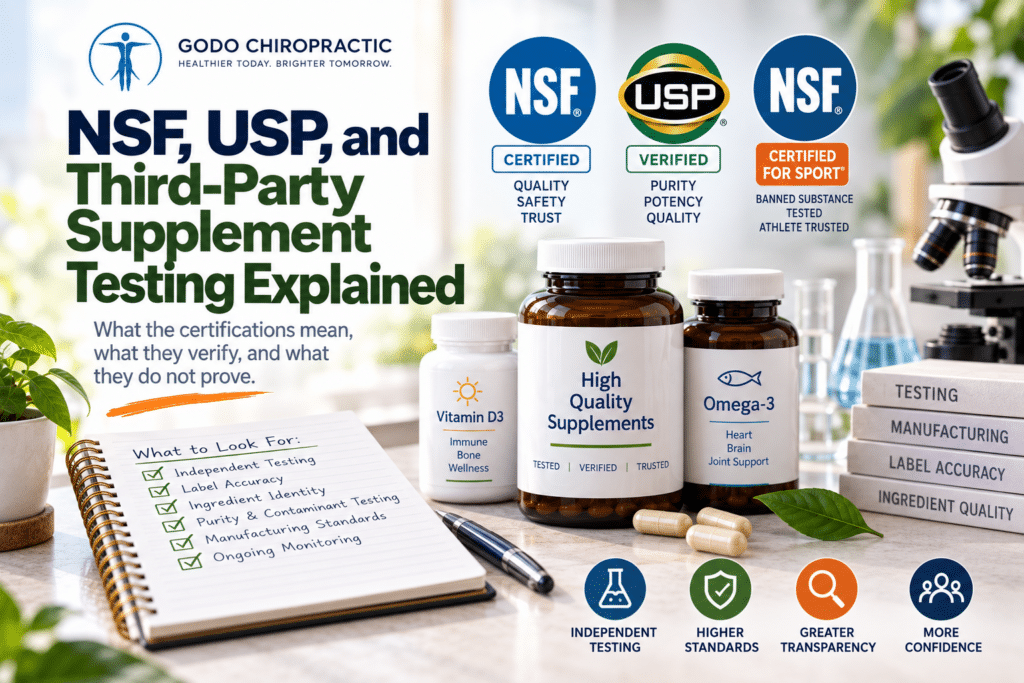
Supplement labels sometimes display terms such as NSF Certified, USP Verified, or third-party tested. Those phrases can provide useful information, but they do not all mean the same thing.
This is where supplement shopping can become confusing. A certification seal may represent a defined verification program, while a phrase such as “third-party tested” may tell you very little unless you know who performed the testing and what was actually evaluated.
Understanding those differences can help you separate meaningful quality verification from reassuring-sounding marketing language.
What Do NSF, USP, and Third-Party Testing Mean?
NSF and USP operate independent programs that evaluate specific aspects of dietary supplement quality. Depending on the program, this may include label accuracy, manufacturing practices, contaminants, ingredient identity, potency, and ongoing product testing. “Third-party tested” is a broader term and should be evaluated by asking who performed the testing and what was actually tested.
Why Does Third-Party Supplement Testing Matter?
Supplement manufacturers are responsible for meeting applicable manufacturing and labeling requirements, but independent testing can provide another layer of verification.
A third-party organization is separate from the manufacturer and may evaluate whether a product meets defined quality standards.
The important point is that not all testing has the same scope. The value of a testing claim depends on the organization involved, the testing methods, the standards being applied, and whether testing is performed once or continues over time.
Testing is therefore one part of a broader quality evaluation. If you are trying to assess the supplement as a whole, our guide on how to know if a supplement is high quality explains the other factors worth considering.
NSF vs USP vs General Third-Party Testing
These terms are sometimes grouped together, but they describe different types of verification.
Independent Certification
NSF offers dietary supplement certification programs that can evaluate label claims, contaminants, ingredients, manufacturing requirements, and ongoing compliance.
USP Verified
USP's verification program includes review of manufacturing and quality systems, laboratory testing, facility auditing, and continued product monitoring.
A Broader Term
“Third-party tested” can mean different things depending on who performed the testing, which tests were used, and what standards were applied.
What Does NSF Certification Mean for Supplements?
NSF operates independent certification programs for dietary supplements. Its general supplement certification program can evaluate whether product contents match label claims and whether products meet defined requirements related to contaminants and manufacturing.
Depending on the certification program, NSF evaluation may include:
- Review of label claims
- Ingredient and product testing
- Evaluation for unacceptable contaminants
- Manufacturing facility review
- Periodic retesting
- Ongoing compliance monitoring
An NSF mark therefore provides more specific information than a manufacturer simply stating that a product has been “quality tested.”
What Is NSF Certified for Sport?
NSF Certified for Sport is a separate certification program designed in part for athletes and organizations concerned about prohibited substances.
Products in the program undergo additional screening for substances prohibited by major sporting organizations.
Regular NSF supplement certification and NSF Certified for Sport are not identical programs. Certified for Sport adds requirements specifically relevant to banned-substance risk.
What Does USP Verified Mean?
USP, or United States Pharmacopeia, operates a voluntary verification program for dietary supplements.
The program evaluates several components of product quality rather than relying on a single laboratory test.
- Manufacturing facility auditing
- Review of quality-control documentation
- Laboratory testing of supplement samples
- Evaluation against applicable quality specifications
- Continued off-the-shelf product testing
Products that successfully meet the program requirements may display the USP Verified Mark.
How Do You Know If a Supplement Is High Quality?
Certification can be valuable, but it is only one part of a larger quality picture. Labeling, formulation, manufacturing, transparency, and distribution matter too.
Read the supplement quality guide →What Does “Third-Party Tested” Actually Mean?
Unlike a specific certification mark, the phrase “third-party tested” by itself does not tell you exactly what was evaluated.
A manufacturer might use an outside laboratory to test one characteristic of a product, while another company may participate in a broader certification program involving manufacturing audits, contaminant testing, and continued monitoring.
That does not make a general third-party testing claim meaningless. It simply means the phrase should lead to another question: what exactly did the independent laboratory verify?
How to Evaluate a Third-Party Testing Claim
You do not need to understand every laboratory method. These six questions can usually tell you whether a testing claim contains meaningful information.
Who Did the Testing?
Look for the name of the laboratory, certification organization, or independent testing body.
What Was Tested?
Determine whether testing addressed identity, potency, purity, contaminants, or another specific characteristic.
Was the Finished Product Tested?
Testing a raw ingredient and testing the finished supplement are not necessarily the same thing.
Is Testing Ongoing?
Some certification programs include periodic retesting or continuing monitoring rather than relying on a one-time sample.
What Standard Was Used?
Meaningful testing should be connected to defined specifications or quality standards.
Can You Verify the Claim?
Major certification organizations typically provide ways to confirm whether a product currently holds their certification.
What Can Supplement Testing Evaluate?
The exact tests vary by product and program, but supplement testing may evaluate:
- Ingredient identity
- Ingredient quantity or potency
- Purity
- Heavy metals
- Microbial contamination
- Undeclared substances
- Other contaminants
- Compliance with defined product specifications
This is why seeing the words “laboratory tested” is less useful than knowing exactly which characteristics were evaluated.
What Is a Certificate of Analysis?
A Certificate of Analysis, commonly abbreviated as COA, is a document that reports testing information for a particular material, product, or batch.
Depending on the product, a COA may report measurements related to identity, potency, purity, contaminants, or other specifications.
A COA can provide useful information, but it still needs context. A document is only as meaningful as the sample that was tested, the testing methods used, the specifications being applied, and the laboratory behind the results.
How to Choose a High-Quality Supplement Brand
Testing tells you something about the product, but the company behind that product matters as well. Manufacturing systems, labeling, transparency, sourcing, and realistic claims all deserve consideration.
Read the supplement brand guide →Browse Professional Supplements and Save 20%
If you already know which supplement brands and products you use, browse eligible products through the Godo Chiropractic Fullscript storefront.
Shop Fullscript & Save 20%Is Third-Party Certification Required by the FDA?
Independent NSF or USP certification is voluntary and is separate from federal requirements that apply to dietary supplement manufacturers.
Dietary supplement manufacturers are subject to FDA Current Good Manufacturing Practice requirements. These address areas such as manufacturing, packaging, labeling, holding operations, quality control, and recordkeeping.
A voluntary third-party certification can therefore provide additional verification beyond a company's statement that it follows applicable requirements.
Does “Professional-Grade” Mean Independently Tested?
Not necessarily. “Professional-grade” describes how products may be marketed or distributed; it does not by itself tell you whether a specific certification or independent testing program was used.
Read: What Are Professional-Grade Supplements? →Does NSF or USP Certification Mean a Supplement Works?
No certification seal should be interpreted as proof that a supplement will produce a particular clinical result.
Quality verification and clinical effectiveness are separate questions. A product can meet defined quality specifications without necessarily being appropriate, necessary, or effective for every person.
This distinction is important because a well-made product and the right product for an individual are not always the same thing.
Does a Supplement Need NSF or USP Certification to Be High Quality?
Not necessarily.
Participation in independent certification programs is voluntary, and not every manufacturer uses the same certification organization.
The absence of an NSF or USP mark does not automatically establish poor quality. Instead, consider the manufacturer's testing practices, transparency, manufacturing systems, ingredient information, and other available evidence.
In other words, certification can strengthen the evidence you have about a product, but it should not become the only thing you look for.
Does Testing Matter When Buying Supplements Online?
Yes, but testing is only part of the online purchasing decision.
You should also be able to identify the seller, understand where the product comes from, and feel reasonably confident about storage and fulfillment. A good certification does not remove the need to evaluate the source selling the product.
If you are purchasing online, our guide to buying professional-grade supplements online explains what to check before placing an order.
Where Can You Buy Practitioner-Grade Supplements Online?
Once you have decided what quality indicators matter to you, the next question is where to buy. Practitioner dispensaries, manufacturers, specialty retailers, and other online sellers can have different distribution and fulfillment models.
Read where to buy practitioner-grade supplements online →Look Beyond the Words “Third-Party Tested”
Independent testing can provide useful evidence about supplement quality, but the details matter.
Look for who performed the testing, what was evaluated, whether meaningful standards were used, and whether the verification continues over time.
Recognized programs such as NSF and USP make those requirements more defined than a vague testing statement printed on a bottle. At the same time, certification should remain one part of your overall evaluation rather than becoming a shortcut for deciding whether a product is right for you.
Supplement Testing FAQs
What does NSF certified mean on a supplement?
NSF certification indicates that a product has met the requirements of an applicable NSF certification program, which may include label review, product testing, contaminant evaluation, and ongoing monitoring.
What does USP Verified mean?
USP Verified indicates that a dietary supplement has successfully completed USP's voluntary verification process, which includes manufacturing review, auditing, laboratory testing, and ongoing product monitoring.
Is NSF better than USP?
They are different programs with their own standards and verification processes. Rather than treating one seal as universally better, consider what the particular certification verifies for the product you are evaluating.
What does third-party tested mean?
It generally means an organization or laboratory independent of the manufacturer performed testing. The term alone does not explain what was tested or which standards were used.
Does third-party testing prove a supplement is safe?
No single testing claim establishes that a supplement is appropriate or risk-free for every person. Testing can verify specific product characteristics, but individual suitability is a separate issue.
Does third-party testing prove that a supplement works?
No. Product quality testing and evidence of clinical effectiveness are different questions.
What is NSF Certified for Sport?
NSF Certified for Sport is a specialized certification program that includes screening for substances prohibited by major sporting organizations in addition to applicable supplement certification requirements.
Where Can You Buy Practitioner-Grade Supplements Online?
Once you understand how to evaluate testing and certification, the next practical question is where to buy. Learn how practitioner dispensaries, manufacturers, and other online sellers differ—and what to look for before ordering.
Read: Where Can You Buy Practitioner-Grade Supplements Online? →Shop Professional Supplements and Save 20%
Browse eligible products through the Godo Chiropractic Fullscript storefront.
Shop Fullscript & Save 20%Disclaimer: This article is for general educational purposes and is not intended to diagnose, treat, cure, or prevent disease or replace individualized healthcare advice. Supplement quality certification does not establish that a product is appropriate or effective for a particular person. Savings apply to eligible products available through the Godo Chiropractic Fullscript dispensary. Product availability, pricing, ordering, payment processing, fulfillment, and shipping are managed through Fullscript.