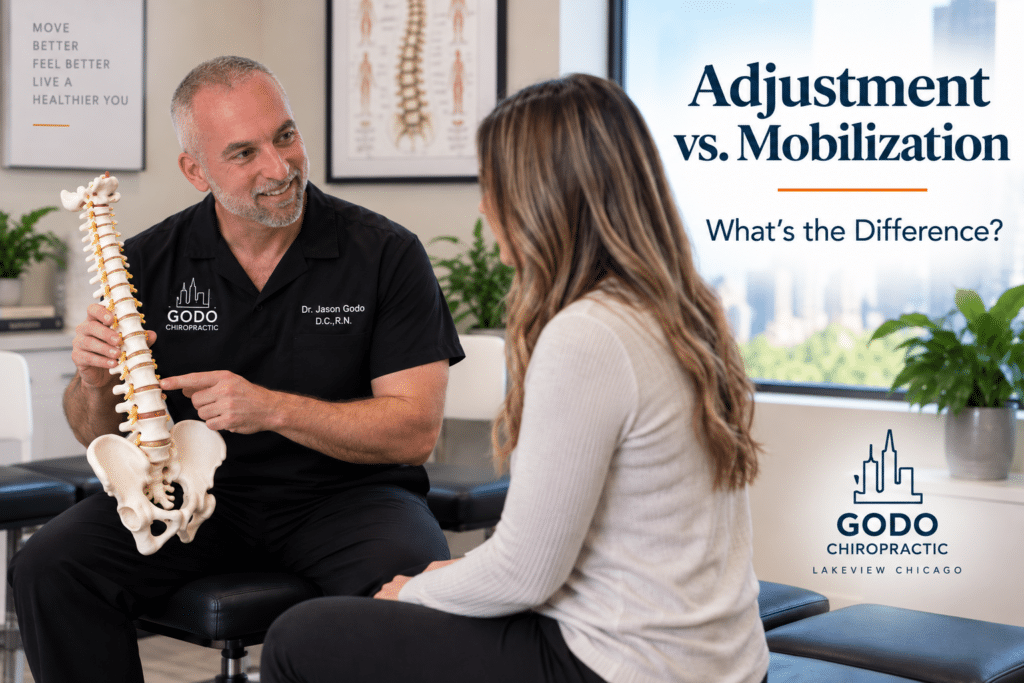
A full-body chiropractic adjustment usually means evaluating and treating more than one region of the body when it is clinically appropriate.
It does not mean every joint should automatically be adjusted, and it should not be based on how many joints can be made to “pop.”
At Godo Chiropractic in Lakeview Chicago, I evaluate patients individually so treatment is based on symptoms, examination findings, comfort, and safety rather than following the same routine for everyone.
Quick Summary: Full-Body Chiropractic Adjustment
- A full-body chiropractic adjustment does not mean every joint needs to be manipulated.
- The examination should determine which areas are appropriate to treat.
- Chiropractors may evaluate the spine, pelvis, shoulders, hips, and extremity joints when clinically relevant.
- An audible pop is not required for an adjustment to be useful.
- Treatment may be modified depending on age, health history, injury, pregnancy, bone health, or neurological findings.
- There is no universal adjustment schedule that is appropriate for every patient.
What Is a Full-Body Chiropractic Adjustment?
The term full-body chiropractic adjustment is commonly used by patients who are looking for care involving more than one area of the body.
In practical terms, it may mean examining several regions and treating multiple joints when the findings indicate that those areas are relevant.
For example, one person may have lower-back pain along with restricted hip movement and stiffness through the mid-back. Another patient may have neck pain, shoulder restriction, and limited upper-back rotation.
Those patients may receive treatment in several areas, but the treatment should still be based on what is found during the evaluation rather than on a preset “full-body” sequence.
Does “Full Body” Mean Every Joint Gets Adjusted?
No. The phrase can create the impression that a chiropractor should adjust every joint during every visit, but that is not how individualized care should work.
One person may need treatment focused primarily on the lower back and pelvis. Another may have findings involving the neck, mid-back, shoulder, hip, or other joints.
The objective should not be to adjust the greatest number of areas. The objective is to determine which areas may actually be contributing to the patient's symptoms, movement restrictions, or recurring problems.
Why Do People Search for Full-Body Chiropractic Adjustments?
People often use the term because they feel stiffness, discomfort, or restricted movement in several areas rather than in one isolated location.
Someone may notice neck tension, mid-back stiffness, lower-back discomfort, and restricted hip movement at the same time.
Others may simply want to know whether a chiropractor evaluates more than the area that currently hurts.
In many cases, it makes sense to look above and below the symptomatic area because the location of pain does not always identify the only area that should be evaluated.
What Should a Chiropractor Evaluate First?
Before deciding whether an adjustment is appropriate, a chiropractor should first understand the patient's history and perform an examination.
Depending on the reason for the visit, the examination may include:
- Range-of-motion testing
- Postural and movement assessment
- Joint mobility testing
- Muscle strength testing
- Neurological or orthopedic testing when indicated
- Palpation of muscles and joints
- Evaluation of previous injuries
- Assessment of recurring pain or movement patterns
At Godo Chiropractic, examination findings may also include Manual Muscle Testing when appropriate.
The purpose is to understand how different areas of the body are functioning together before deciding what treatment makes sense.
Which Areas of the Body May Be Adjusted?
Neck
Neck mobility may be evaluated when a patient has stiffness, headaches, posture-related discomfort, or restricted movement.
Mid-Back
Thoracic mobility can influence rotation, posture, breathing mechanics, and how the neck and shoulders move.
Lower Back
The lumbar spine is commonly evaluated in people with recurring stiffness or back pain.
Pelvis and SI Joints
Pelvic and sacroiliac mechanics may be assessed when lower-back, hip, or leg symptoms are present.
Shoulders and Hips
These larger joints may be evaluated when movement restrictions appear to affect posture, sports activity, or daily function.
Extremity Joints
Knees, ankles, elbows, wrists, and other joints may be examined when symptoms or movement findings indicate a reason to do so.
Do You Need to Hear a Pop During an Adjustment?
No. The sound commonly associated with a chiropractic adjustment is not the objective of treatment.
The sound can occur when pressure changes inside a joint produce a small release of gas.
An adjustment can still be clinically useful even when no audible sound occurs.
A quieter adjustment does not automatically mean the treatment was unsuccessful, and a louder adjustment does not mean it was more effective.
What Does a Full-Body Chiropractic Adjustment Feel Like?
The experience varies depending on the technique being used, the patient's condition, and the area being treated.
Some adjustments involve a quick, controlled movement applied to a joint. Other techniques use slower mobilization, lighter pressure, positioning, or assisted movement.
Patients may notice a sense of increased movement or decreased stiffness afterward, but the response is not identical for everyone.
Some people also experience temporary muscle soreness after treatment, particularly when they have not been moving normally for a period of time.
Is a Full-Body Chiropractic Adjustment Appropriate for Everyone?
No. The phrase “full body” should never imply that every patient should receive the same series of adjustments.
Age, injury history, bone health, neurological symptoms, recent surgery, medications, pregnancy, and other health considerations can affect which techniques are appropriate.
In some cases, a gentler technique may be preferable. In others, treatment may need to be modified, postponed, or directed toward a different type of care entirely.
Important: A patient should not be adjusted simply because a particular technique is popular online or because a “full-body” routine is commonly shown on social media.
How Long Does a Chiropractic Adjustment Take?
The adjustment itself may take only a few minutes, but that does not mean the entire visit should be reduced to a few minutes of manipulation.
A first visit typically takes longer because the chiropractor needs to review the patient's history, perform an examination, determine whether treatment is appropriate, and explain the findings.
If you are preparing for your first appointment, you can read more about what to expect at your first chiropractic visit.
How Often Should You Get Adjusted?
There is no single schedule that is appropriate for everyone.
Frequency can depend on the reason for care, how long the problem has been present, examination findings, activity level, response to treatment, and whether the symptoms continue to return.
Some patients may need only a small number of visits, while others may require more time because the underlying problem is recurrent or influenced by work, training, posture, or repetitive movement.
If symptoms repeatedly return, it may be useful to consider why the problem keeps recurring rather than focusing only on temporary relief. You can read more in Why Your Pain Keeps Coming Back.
What Should You Expect After an Adjustment?
Many patients return to normal activity after a routine chiropractic visit.
Some notice an immediate change in movement or stiffness, while others experience more gradual improvement.
Mild soreness can sometimes occur, especially when an area has been restricted or irritated.
Your chiropractor may recommend movement, stretching, strengthening, activity modification, or other strategies depending on the examination findings.
When Should Chiropractic Adjustment Be Avoided or Modified?
Certain symptoms or medical conditions require additional caution and may change whether or how chiropractic treatment is performed.
A chiropractor should screen for factors such as:
- Significant recent trauma
- Suspected fracture
- Progressive neurological symptoms
- Severe unexplained pain
- Certain bone conditions
- Recent surgery
- Other findings that may require medical evaluation first
This is another reason an examination matters. The question should not simply be, “Can this joint be adjusted?” It should be, “Is adjusting this area appropriate for this patient today?”
Related Chiropractic Guides
Frequently Asked Questions About Full-Body Chiropractic Adjustments
What is considered a full-body chiropractic adjustment?
A full-body chiropractic adjustment generally refers to evaluating and treating multiple areas of the body when appropriate. It does not require adjusting every joint during the same visit.
Does a chiropractor adjust your entire body?
Not necessarily. A chiropractor should examine the patient first and treat only the areas that are clinically appropriate based on symptoms and findings.
Do chiropractic adjustments have to crack or pop?
No. An audible pop is not required for an adjustment to be useful. The sound is related to pressure changes within a joint and is not the goal of treatment.
Can chiropractors adjust hips, shoulders, knees, or other joints?
Chiropractors may evaluate and treat extremity joints when clinically appropriate. Treatment depends on the patient's condition, examination findings, and the chiropractor's training.
How often should someone get a chiropractic adjustment?
There is no universal schedule. Frequency depends on the patient's condition, examination findings, response to care, activity level, and treatment goals.
Is a full-body chiropractic adjustment safe?
Treatment should be individualized after an appropriate history and examination. Certain health conditions or symptoms may require modified techniques, additional evaluation, or referral before chiropractic treatment is performed.
Have Your Movement and Joint Function Evaluated
If you are dealing with recurring stiffness, back pain, sciatica, or discomfort in several areas of the body, an evaluation can help determine which joints and movement patterns may actually be contributing.
Godo Chiropractic serves patients in Lakeview Chicago and surrounding neighborhoods.
Schedule Your $29 EvaluationFinal Thought
A full-body chiropractic adjustment should not be defined by how many joints are manipulated or how many audible pops occur during a visit.
The more useful question is whether the areas being treated are actually related to the patient's symptoms, movement restrictions, examination findings, and overall function.
In some patients, that may involve several regions of the body. In others, a more focused approach may be appropriate. The examination should determine the treatment rather than the treatment being decided before the examination begins.
At Godo Chiropractic, I evaluate patients from Lakeview, Lincoln Park, Wrigleyville, Uptown, River North, and surrounding Chicago neighborhoods who want to better understand recurring pain, stiffness, and movement problems.
Godo Chiropractic
Lakeview Chicago