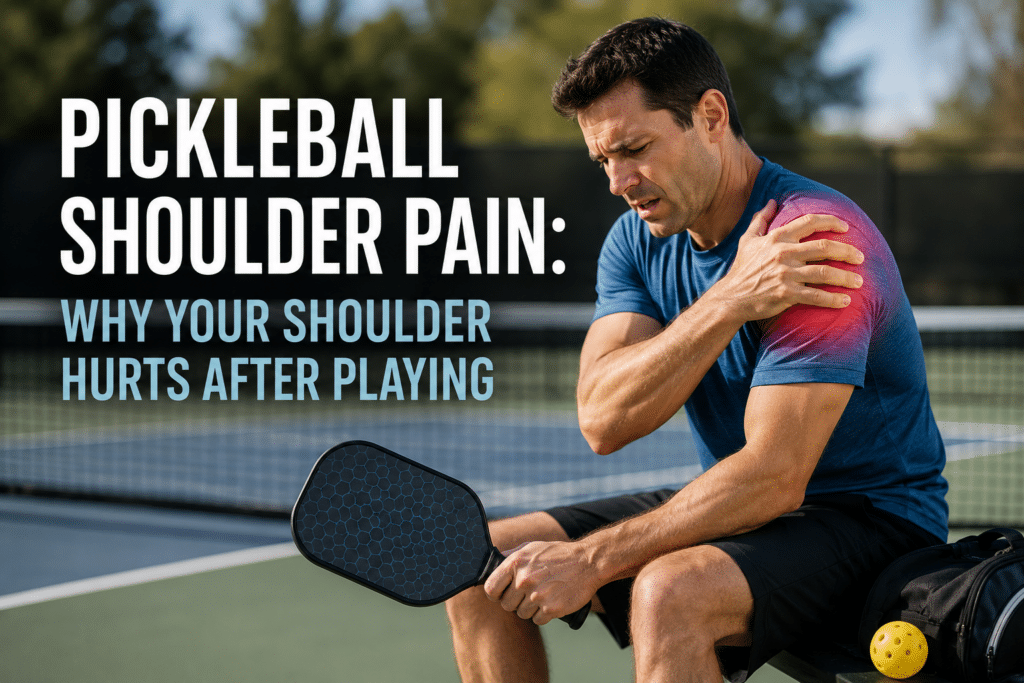
Pickleball shoulder pain can develop from serving, overhead shots, repetitive reaching, quick reactions, and playing more often than your shoulder is prepared to tolerate.
For some players, the shoulder feels sore after a long session. For others, pain begins during an overhead shot, while reaching for a wide ball, or when lifting the arm later that day.
At Godo Chiropractic in Lakeview Chicago, I evaluate active patients who want to understand what may be contributing to recurring shoulder pain so they can keep moving and stay active.
Understanding Pickleball Shoulder Pain
The shoulder has a large range of motion, which is useful for sports but also means that several joints, muscles, tendons, and movement patterns must work together efficiently.
Pickleball repeatedly asks the shoulder to accelerate, decelerate, reach, stabilize the paddle, and react quickly to changing ball positions.
Sometimes the shoulder itself is the main problem. In other cases, the neck, shoulder blade, upper back, elbow, wrist, or overall movement pattern may contribute to the stress reaching the shoulder.
If you are dealing with pain in more than one area after playing, you may also want to review our broader guide to pickleball injuries in Chicago.
Quick Summary: Pickleball Shoulder Pain
- Pickleball shoulder pain may develop from repetitive serving, overhead shots, reaching, or overuse.
- Rotator cuff muscles and tendons are commonly stressed during repetitive overhead movement.
- Shoulder blade control, upper back mobility, and neck mechanics can influence shoulder stress.
- Pain may occur while serving, reaching overhead, lifting the arm, sleeping, or after playing.
- Rest may temporarily reduce symptoms, but recurring pain deserves a closer evaluation.
- The right approach depends on what is contributing to the pain, not simply where the pain is felt.
Why Pickleball Can Irritate the Shoulder
Pickleball may look less demanding than some racquet sports, but the shoulder still performs hundreds of repetitive movements during play.
Common sources of shoulder stress include:
- Repeated serving
- Overhead shots
- Reaching for wide or high balls
- Fast volleys near the net
- Sudden changes in paddle position
- Playing several days per week
- Returning to play too quickly after soreness begins
- Increasing playing time faster than the body can adapt
The problem is often not one single motion. Instead, repeated loading accumulates until the shoulder no longer tolerates the same amount of activity comfortably.
Common Causes of Pickleball Shoulder Pain
Shoulder pain after pickleball can have several possible contributors. The location of the pain alone does not always identify the source.
Shoulder Factors
- Rotator cuff irritation
- Shoulder impingement
- Biceps tendon irritation
- Joint irritation
- Shoulder blade control problems
- Muscle fatigue or weakness
Movement Factors
- Limited upper back rotation
- Neck tension
- Poor serving mechanics
- Grip and wrist compensation
- Rapid increases in playing volume
- Insufficient recovery between sessions
Rotator Cuff Irritation and Pickleball
The rotator cuff is a group of muscles and tendons that helps stabilize and control the shoulder while the arm moves.
During pickleball, the rotator cuff works repeatedly when you serve, reach, swing, slow the paddle after a shot, and stabilize the arm during fast exchanges.
Possible symptoms may include:
- Pain on the outside or front of the shoulder
- Pain when lifting the arm
- Discomfort reaching overhead
- Pain after playing
- Weakness with certain movements
- Difficulty sleeping on the painful shoulder
Not every case of shoulder pain is a rotator cuff problem, which is why a broader examination can be useful when symptoms persist.
Shoulder Impingement and Overhead Shots
Some players describe a pinching sensation when the arm moves overhead. This type of pain is often described as shoulder impingement, although several different structures and movement patterns may contribute.
Overhead shots can become more irritating when the shoulder blade does not move efficiently, the upper back is stiff, the rotator cuff fatigues, or the arm repeatedly works in the same painful range.
Common complaints include:
- Pinching while raising the arm
- Pain during overhead shots
- Discomfort reaching into a cabinet
- Pain putting on a shirt or jacket
- Soreness after serving or repeated volleys
How Serving Mechanics Affect the Shoulder
A pickleball serve involves more than the shoulder. The legs, hips, trunk, shoulder blade, arm, wrist, and grip all contribute to the movement.
If the hips and trunk contribute less motion, the shoulder may be asked to create more of the swing by itself. Likewise, poor shoulder blade control or fatigue can change how the arm moves during repeated serves.
Players may notice that pain becomes worse:
- Later in a match
- After several games
- When trying to hit harder
- When reaching farther away from the body
- After increasing how often they play
Similar overhead-mechanics issues can occur in tennis. For comparison, see our article on tennis shoulder pain and serving.
When Shoulder Pain May Involve the Neck or Upper Back
Not all shoulder pain begins in the shoulder itself.
The neck and upper back can influence shoulder movement, muscle control, posture, and nerve function. Limited upper back rotation may also force the shoulder to compensate during reaching and overhead activity.
Clues that another area may be contributing can include:
- Neck stiffness along with shoulder pain
- Pain around the shoulder blade
- Tingling or numbness into the arm or hand
- Symptoms that change with neck movement
- Weakness that does not feel like simple muscle fatigue
Our broader guide to shoulder pain from sports explains how shoulder, neck, upper back, and sport-specific mechanics can interact.
What You Can Do When Your Shoulder Hurts After Pickleball
The right response depends on how the pain started, how severe it is, and whether there are signs of a more significant injury.
For mild soreness, reasonable early steps may include:
- Reducing painful playing volume temporarily
- Avoiding repeated movements that clearly increase symptoms
- Allowing adequate recovery between sessions
- Maintaining comfortable shoulder movement
- Reviewing serving and overhead mechanics
- Gradually rebuilding strength and playing volume
The goal is not simply to stop using the shoulder indefinitely. It is to identify what is aggravating the area and determine how activity can be reintroduced appropriately.
When Pickleball Shoulder Pain Should Be Evaluated
Shoulder pain deserves closer evaluation when it is persistent, worsening, or interfering with normal activity.
Seek appropriate medical evaluation if you experience:
- Significant weakness after an injury
- Inability to raise the arm normally
- Visible deformity
- Severe swelling or bruising
- A sudden traumatic injury
- Numbness or progressive weakness into the arm or hand
- Severe pain that does not improve
- Symptoms associated with chest pain, shortness of breath, or other medical warning signs
How I Evaluate Pickleball Shoulder Pain in Lakeview Chicago
When someone comes into Godo Chiropractic with shoulder pain, I do not assume that the painful area is automatically the only problem.
An evaluation may include looking at:
- Shoulder range of motion
- Rotator cuff and shoulder muscle function
- Shoulder blade movement
- Neck and upper back mobility
- Posture and movement patterns
- Strength and muscle balance
- Orthopedic and neurological findings when appropriate
- How the symptoms relate to pickleball movements
The purpose is to determine which factors appear most relevant to the pain and whether chiropractic care may be appropriate.
Related Pickleball and Sports Injury Guides
- Pickleball Injuries in Chicago: Shoulder, Elbow, Back, and Knee Pain
- Pickleball Elbow: Why Your Elbow Hurts After Playing
- Pickleball Knee Pain: Why Your Knee Hurts After Playing
- Shoulder Pain from Sports: Volleyball, Tennis, Pickleball & Weightlifting
- Tennis Shoulder Pain: Why Serving and Overhead Shots Can Hurt
Frequently Asked Questions About Pickleball Shoulder Pain
Why does my shoulder hurt after playing pickleball?
Shoulder pain after pickleball may be related to repetitive serving, overhead shots, reaching, rotator cuff fatigue, shoulder blade control, limited upper back mobility, or increasing playing volume faster than the shoulder can tolerate.
Can pickleball cause rotator cuff pain?
Repeated overhead movement and paddle control can place stress on the rotator cuff. However, shoulder pain can come from several different structures, so persistent symptoms should not automatically be assumed to be a rotator cuff problem.
Why does my shoulder hurt when I serve in pickleball?
Serving repeatedly loads the shoulder while the trunk, shoulder blade, arm, wrist, and grip coordinate the swing. Pain may become more noticeable when the shoulder is fatigued, mechanics change, or playing volume increases.
Should I stop playing pickleball if my shoulder hurts?
That depends on the severity and cause of the pain. Mild soreness may respond to temporarily reducing aggravating activity, while persistent, worsening, traumatic, or function-limiting pain should be evaluated before continuing to play through it.
Can neck problems cause shoulder pain while playing pickleball?
Yes. The neck, upper back, nerves, and shoulder blade mechanics can influence symptoms around the shoulder. Neck stiffness, tingling, numbness, or symptoms that change with neck movement may warrant evaluating more than the shoulder alone.
Can a chiropractor evaluate pickleball shoulder pain?
A chiropractor can evaluate musculoskeletal contributors such as shoulder movement, strength, posture, shoulder blade mechanics, neck and upper back function, and sport-related movement patterns. Appropriate referral may be needed when examination findings suggest a condition outside chiropractic care.
Have Your Shoulder Pain Evaluated
If pickleball shoulder pain keeps returning, affects your game, or interferes with normal activity, an evaluation can help determine what may be contributing.
Godo Chiropractic serves active patients in Lakeview Chicago and surrounding neighborhoods.
Schedule Your $29 EvaluationFinal Thought
Pickleball shoulder pain is often less about one isolated movement and more about how serving, reaching, overhead activity, recovery, shoulder mechanics, and the rest of the body work together over time.
If shoulder pain keeps returning, affects your serve or overhead shots, or begins interfering with normal activity, it may be worth looking beyond the painful area itself to understand what is contributing.
At Godo Chiropractic, I evaluate active patients from Lakeview, Lincoln Park, Wrigleyville, Uptown, River North, and surrounding Chicago neighborhoods who want to understand the cause of recurring shoulder and sports-related pain.
Godo Chiropractic
Lakeview Chicago