
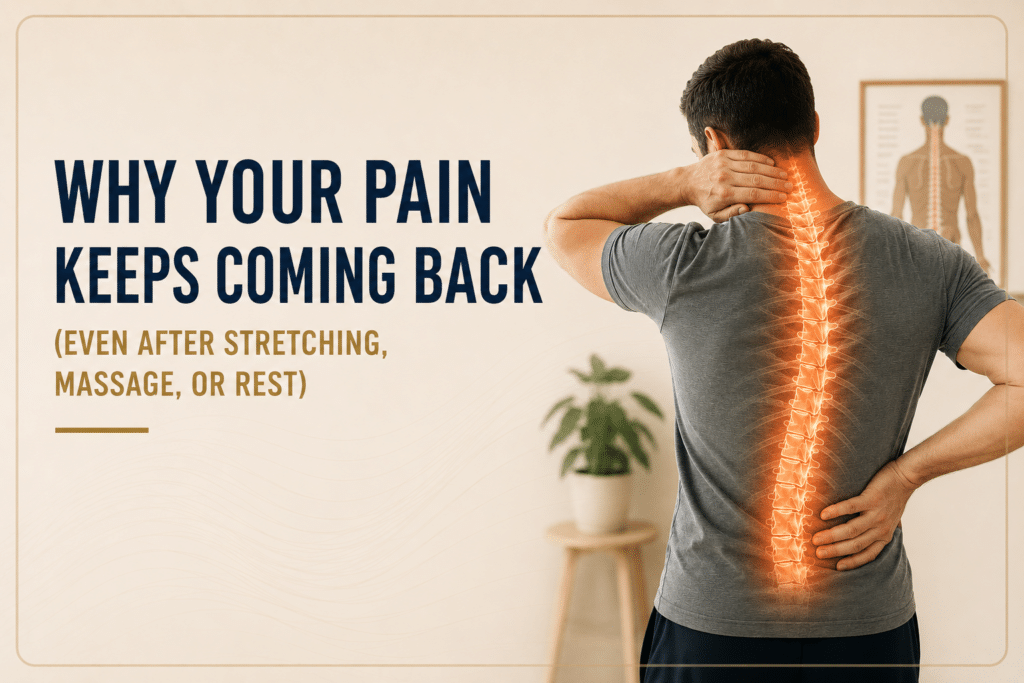
Sometimes the problem isn’t the pain itself—it’s the pattern behind it.
If you’ve been dealing with recurring pain for months or even years, you’ve probably tried at least a few things already.
Maybe you’ve:
- stretched regularly
- used a massage gun
- rested for a few days
- changed pillows
- taken pain medication
- tried heat or ice
Sometimes those things help temporarily. However, the pain eventually returns. That’s where frustration usually starts. Many patients begin wondering: “Why does this keep happening?”
Often, recurring pain involves deeper structural stress, posture issues, movement dysfunction, or compensation patterns that temporary relief methods never fully address.
Quick Answer
Pain often keeps coming back because the underlying cause hasn’t been properly identified. While stretching, massage, or rest may temporarily reduce symptoms, recurring pain frequently involves posture stress, movement dysfunction, muscle imbalance, or structural compensation patterns that continue irritating the body over time.
Temporary Relief Isn’t Always the Same as Solving the Problem
One of the biggest misunderstandings about pain is assuming symptom relief automatically means the problem has been corrected.
For example:
- stretching may loosen tight muscles temporarily
- massage may reduce tension for a short time
- rest may calm inflammation briefly
However, if the underlying stress pattern remains, symptoms often return once normal activity resumes.
That’s why many people feel trapped in a cycle of:
- temporary improvement
- recurring flare-ups
- frustration
- repeated treatment attempts
Why the Body Starts Compensating
The body constantly adapts to stress.
When one area loses mobility or stability, another area often compensates to keep movement functioning.
Over time, those compensation patterns can create:
- chronic muscle tension
- uneven stress on joints
- reduced mobility
- recurring irritation
- persistent pain patterns
For example:
- poor hip mobility may increase lower back stress
- forward head posture may contribute to headaches
- uneven movement patterns may overload certain muscles repeatedly
Often, symptoms develop gradually long before pain becomes severe enough to notice.
Poor Posture Adds Stress Throughout the Day
Posture affects more than most people realize.
Hours spent:
- sitting at a desk
- driving
- looking down at phones
- working on computers
- leaning forward
can slowly increase stress throughout the spine and surrounding muscles.
As a result, the body begins adapting to those positions.
Over time, that constant stress may contribute to:
- neck pain
- headaches
- shoulder tension
- lower back pain
- stiffness
- recurring flare-ups
That’s one reason recurring pain often feels worse after long workdays or extended sitting.
Movement Dysfunction Often Gets Overlooked
Many people focus only on where pain hurts.
However, movement dysfunction often starts somewhere else.
For example, recurring lower back pain may involve:
- limited hip mobility
- pelvic imbalance
- poor core stability
- restricted spinal movement
Similarly, recurring neck pain may involve:
- shoulder mechanics
- posture adaptation
- muscle imbalance
- upper back restriction
That’s why simply chasing symptoms sometimes leads to temporary relief without long-term improvement.
Why Imaging Doesn’t Always Explain Pain
Many patients assume imaging will automatically reveal the full cause of their pain.
Sometimes imaging helps.
However, pain patterns also involve:
- movement quality
- muscle function
- compensation
- posture stress
- mobility restrictions
In other words, two people may have similar imaging results while experiencing very different symptoms.
That’s why evaluating how the body functions is often just as important as looking at structural findings alone.
The Body Usually Warns You Before Symptoms Become Severe
The body rarely develops chronic pain overnight.
Instead, most recurring pain patterns build gradually over time.
At first, symptoms may seem minor:
- occasional stiffness
- mild tension
- soreness after activity
- headaches once in a while
However, when stress patterns continue long enough, the body eventually struggles to compensate.
That’s often when recurring pain becomes more noticeable.
Short Patient Example
A patient recently came into our Chicago office after dealing with recurring lower back and neck tension for nearly a year.
They had already tried:
- stretching programs
- massage therapy
- ergonomic changes
- rest periods
Although those approaches helped temporarily, the pain kept returning.
During the evaluation, we found several movement and posture patterns contributing to ongoing stress throughout the spine.
Once the patient understood how those compensation patterns affected the body over time, the recurring flare-ups finally started making more sense.
Common Mistake Patients Make
One of the biggest mistakes people make is focusing only on reducing symptoms, rather than understanding why they developed in the first place.
That often leads to:
- chasing temporary relief
- repeated flare-ups
- ongoing frustration
Instead, identifying the underlying stress pattern usually creates a much clearer path forward.
When to Seek an Evaluation
You should consider a professional evaluation if:
- pain repeatedly returns
- stretching only helps temporarily
- symptoms worsen with sitting or work
- headaches or tension are becoming more frequent
- stiffness keeps affecting daily activity
- you feel like you still don’t understand the root cause
$29 New Patient Evaluation
Our $29 New Patient Evaluation includes:
- consultation
- posture assessment
- movement evaluation
- and personalized recommendations based on your findings
The goal is to help identify why symptoms may keep returning and what stress patterns may be contributing to the problem.
Click here to learn more about this special offer.
Final Thought
Pain that keeps returning usually has a reason behind it.
When patients finally understand how posture, movement, compensation, and structural stress interact together, the recurring pattern often starts making much more sense.


